

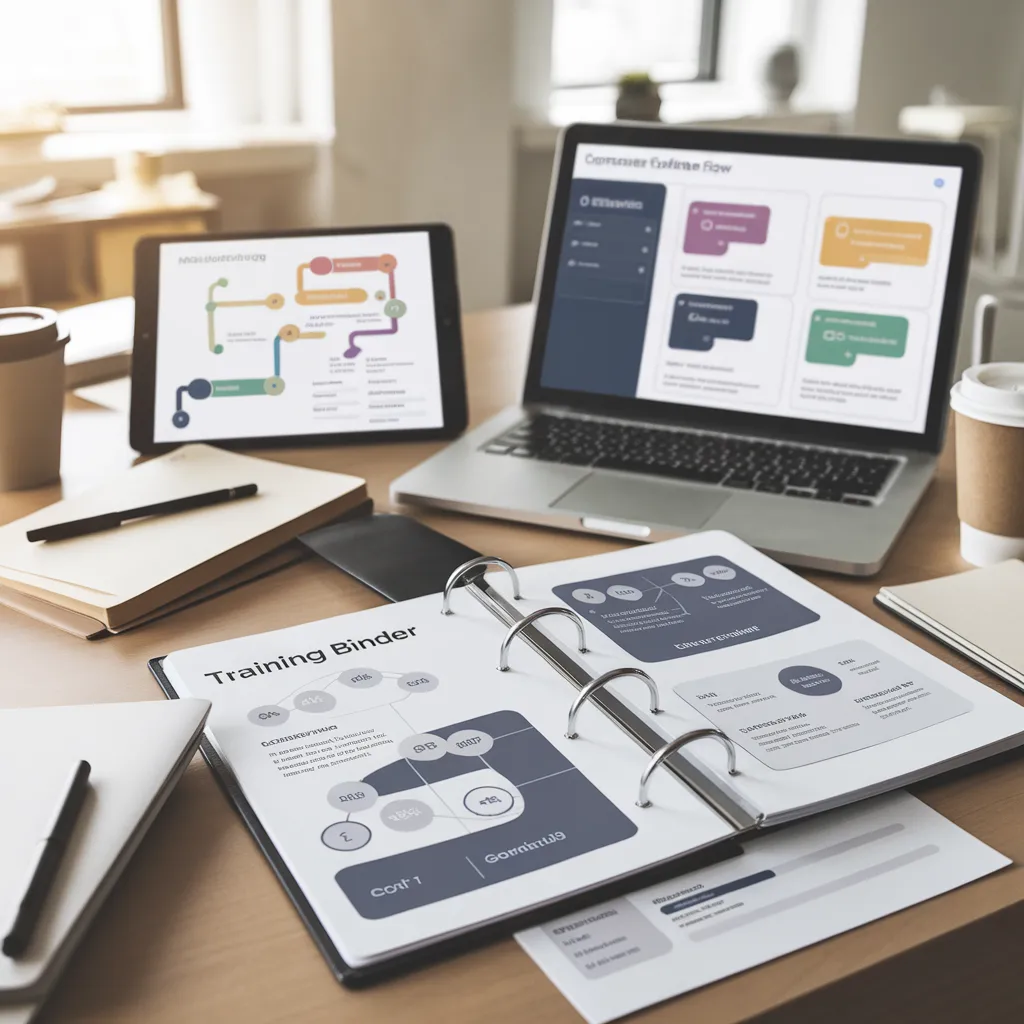

Customer Service Excellence Training Kit
The Complete Staff Training Program for Delivering the Salon and Barbershop Client Experience That Generates Five-Star Reviews, Loyal Regulars, and Constant Referrals
A five-star review is not left after a haircut.
It is left after a feeling. The feeling of being genuinely welcomed when you walked through the door before anyone checked what appointment you had. The feeling of being consulted with — actually listened to — rather than being told what would look good. The feeling of being offered water or coffee without having to ask. The feeling that the stylist remembered what you said about your daughter’s recital last time. The feeling of leaving with not just the result you wanted but the sense that you found a place that is yours.
Technical excellence is the minimum requirement for a client to return. It is not the reason they refer their friends, leave the five-star review, or refuse to go anywhere else even when they move neighborhoods. That loyalty — the kind that sustains a salon through lean periods, generates word-of-mouth without any advertising spend, and makes new staff immediately inherit a full book — comes from the experience.
The experience is not accidental. It is trained.
The Li-Bar Customer Service Excellence Training Kit is the complete training program for every member of the salon or barbershop team — from the front desk to the senior stylist — covering every touchpoint in the client journey from the first phone call to the post-visit follow-up.
📥 Li-Bar digital exclusive. Instant download.
THE TRAINING KIT — MODULE BY MODULE
MODULE ONE: THE CLIENT EXPERIENCE PHILOSOPHY
The Li-Bar Standard — What Excellence Actually Means in Practice
The training begins not with scripts but with understanding — because scripts without understanding produce robotic, inauthentic service that clients can feel immediately. This module establishes the philosophy that all subsequent training is built on.
The four-principle client experience philosophy:
Principle One — Every client is a guest. The distinction between the transactional mindset (“I am performing a service for a customer”) and the hospitality mindset (“I am hosting a guest in my space”). The practical difference: a customer is managed; a guest is welcomed. The behavioral implications of this distinction at every touchpoint — the greeting that feels like an arrival rather than a check-in, the offer of refreshment that is genuine rather than perfunctory, the farewell that feels like a send-off rather than a dismissal.
Principle Two — Attention is the primary service. The client who sits in a stylist’s chair for sixty to ninety minutes is, for that period, the full focus of that stylist’s attention. The phone face-down rule, the conversation depth standard, the consultation quality standard, and the silence comfort (the stylist who is comfortable with occasional silence serves the client who does not want to talk just as well as the one who loves to chat — the training that distinguishes social energy from presumptuous chatter).
Principle Three — Problems are opportunities. The client who has a complaint that is handled brilliantly becomes a more loyal client than one who never had a complaint. The training on receiving feedback, acknowledging dissatisfaction, and resolving issues without defensiveness — the protocol that turns a negative experience into the story the client tells their friends about how well they were treated.
Principle Four — Consistency is the foundation of trust. The client who experiences variable service — excellent one visit, adequate the next, frustrating the third — never fully commits to the salon. The consistency standard: the minimum level of service quality that every client receives on every visit, regardless of how busy it is, regardless of which staff member they are with, regardless of whether they are a new client or a regular. ✨
MODULE TWO: THE COMPLETE CLIENT JOURNEY TRAINING
Stage One: The First Contact
The Phone Booking Experience: The conversation that begins the client relationship before they have ever seen the salon. The training covers: the phone manner (the greeting script that is warm and professional without feeling rehearsed, the tone that communicates genuine welcome over the phone), the consultation questions for new clients (the questions that establish what the client wants, what they have had done before, what their time and budget considerations are, and which stylist is the right match for their needs), the confirmation of expectations (the pricing transparency conversation that prevents the surprise at checkout that generates more negative reviews than any other single salon experience), and the booking confirmation communication (the text or email that confirms the appointment and provides everything the client needs to arrive prepared and on time).
The Online Booking Experience: The digital equivalent of the phone booking — the booking platform setup that communicates the brand, the service descriptions that accurately set expectations, the automated confirmation message that sounds human rather than administrative, and the pre-appointment information message that prepares the client for what to expect on their visit.
Stage Two: The Arrival Experience
The First Thirty Seconds: The research on first impressions in service environments is clear: the client’s assessment of the experience begins the moment they enter, and the first thirty seconds disproportionately shape their overall impression of the visit. The arrival training covers: the eye contact and acknowledgment (the staff member who looks up and makes eye contact within the first fifteen seconds of a client entering — regardless of what they are doing — communicates immediate welcome; the staff member who continues what they are doing for thirty seconds before acknowledging the client has already created a slightly negative impression), the greeting language (the greeting that uses the client’s name when known, that acknowledges whether it is a first visit, and that communicates that their arrival was expected), the coat and bag offer, the waiting area introduction, and the refreshment offer with genuine options rather than perfunctory asking. 🪑
The Waiting Experience Management: The client who waits more than five minutes without acknowledgment is a client who is already slightly dissatisfied before the service begins. The waiting experience protocol: the update communication (the staff member who checks on a waiting client every five minutes when the wait exceeds the expected time), the genuine apology for delay (not “sorry for your wait” as a reflexive statement but a specific acknowledgment of the delay with an updated time), and the waiting area environment standard (the cleanliness, the magazine currency, the music level, and the ambient temperature that collectively communicate that the space is maintained with care).
Stage Three: The Consultation
The Consultation Protocol: The consultation is the most important stage of the service, the stage most often rushed, and the stage most directly responsible for the quality of the outcome. The training covers the complete consultation methodology:
The active listening standard: the stylist who puts down every tool, faces the client, and gives the consultation their full attention produces meaningfully better consultation outcomes than the one who multitasks. The training for the physical consultation posture (the positioning that communicates full attention) and the verbal listening signals (the responses that confirm understanding without interrupting).
The question sequence: the open question that invites the client to describe what they want without constraint (“Tell me about what you’re thinking for today — what would make you leave here happy?”), followed by the clarifying questions that resolve ambiguity (“When you say you want to go lighter, are you thinking sun-kissed natural highlights or a more dramatic change?”), followed by the lifestyle questions that ensure the result will work in the client’s actual life (“How much time do you spend styling in the morning?” “How often can you realistically come back for maintenance?”), and finally the recommendation (the stylist’s professional input that synthesizes what they heard with what they know is achievable, maintainable, and genuinely suited to the client’s hair type and face shape).
The expectation confirmation: the specific, visual confirmation of the agreed outcome before any service begins — the reference image, the verbal description confirmed back to the client, the acknowledgment of any limitations or modifications from the original request. The two minutes spent on expectation confirmation prevent the hour-long conversation after the service is complete. 📋
Stage Four: The Service Experience
The During-Service Standards: The service experience standards that distinguish excellent from adequate: the service commencement communication (the explanation of what is being done and why at each stage — the client education that makes the visit feel like an expert experience rather than a passive one), the check-in at each stage of chemical services (the comfort check, the color development visual, the processing time explanation), the product recommendation timing (the during-service product recommendation that arises naturally from what the stylist is observing rather than feeling like a sales pitch), and the silence and conversation balance (the stylist’s social awareness that adapts the level of conversation to each individual client’s preference).
Stage Five: The Reveal and Departure
The Result Presentation: The moment of showing the client their finished result is the most emotionally charged moment of the visit — the moment that determines the emotional memory they carry away and whether they rebook before leaving. The training: the mirror presentation technique, the verbal framing of the result (the language that invites the client’s genuine reaction without leading them toward a specific response), the styling explanation (the techniques and products used and how to recreate the style at home), and the product recommendation at departure (the natural, non-pressured product recommendation grounded in what the stylist used and why — the recommendation that makes the client feel cared for rather than upsold).
The Rebooking Conversation: The most important revenue conversation in the salon — and the one most often skipped because it feels like selling. The training: the rebooking framing that positions the next appointment as maintaining the result the client just paid for rather than as generating another sale, the specific timing recommendation for each service type, and the language that makes the client feel the recommendation is for their benefit. 💇
MODULE THREE: THE DIFFICULT SITUATIONS TRAINING
The Complaint Resolution Protocol
The AARF framework for handling every client complaint, at every level of severity:
Acknowledge: The immediate, specific acknowledgment of what the client has expressed dissatisfaction with — no defensive qualification, no explanation, no context before the acknowledgment. “You’re not happy with the way the fringe has been cut — I completely understand.”
Apologize: The genuine apology for the experience, not the defensive non-apology. The training on the language distinction: “I’m sorry you feel that way” is a non-apology that inflames; “I’m sorry this isn’t right for you” is a genuine acknowledgment that de-escalates.
Resolve: The specific action taken to address the problem — the correction, the adjustment, the complimentary service, the refund where appropriate. The resolution authority framework: which staff members have authority to offer which resolutions without management approval, and the escalation process when the resolution required exceeds that authority.
Follow up: The check-in after the resolution — the call or message the following day confirming the client is satisfied with how the situation was handled. The follow-up that converts a complaint-handling experience into a loyalty-building moment.
The Difficult Client Situations Guide
Specific training scenarios for the most challenging client interactions: the client who is unhappy with a result that matches what was requested but not what they hoped for, the client who is rude to staff under stress or frustration, the client who arrives late and expects full service, the client who requests a service that the stylist cannot ethically provide in good conscience, and the client who is showing signs of dissatisfaction during the service rather than after. Each scenario with the recommended response language, the de-escalation approach, and the resolution options. 🔧
MODULE FOUR: THE TEAM STANDARDS AND CULTURE
The Professional Conduct Standards
The behavioral standards that apply to every team member in client-facing situations: the phone usage policy (the policy that is clear, fair, and explained rather than assumed), the punctuality standard, the appearance and uniform standard, the language standard (the words and topics that are appropriate and inappropriate in client conversations — the political conversation, the personal complaint about colleagues, the negative comment about another salon), and the confidentiality standard (the client information shared in the chair is confidential and does not leave the salon floor).
The Team Training Assessment System
The evaluation framework for confirming that training has been absorbed and is being applied: the mystery client assessment template (the structured evaluation form for an unannounced quality check visit), the peer observation checklist (the system for team members to give and receive feedback on service standards), and the monthly service quality review (the team meeting agenda item that reviews any complaints received, identifies patterns, and updates training based on observed gaps). 📊
📂 COMPLETE LI-BAR FILE SUITE
📋 Complete Training Kit PDF — all four modules | ✨ Li-Bar Client Experience Standards Quick Reference (laminate-ready card, A5 format) | 📝 Consultation Protocol Script and Question Guide (editable) | 🔧 AARF Complaint Resolution Framework and Scenario Library (PDF) | 📊 Mystery Client Assessment Template (editable) | ✅ New Staff Training Completion Checklist (editable) | 💬 Phone Booking Script Template (editable) | 🗓️ Monthly Service Quality Review Agenda Template (editable)
Reviews
There are no reviews yet.