
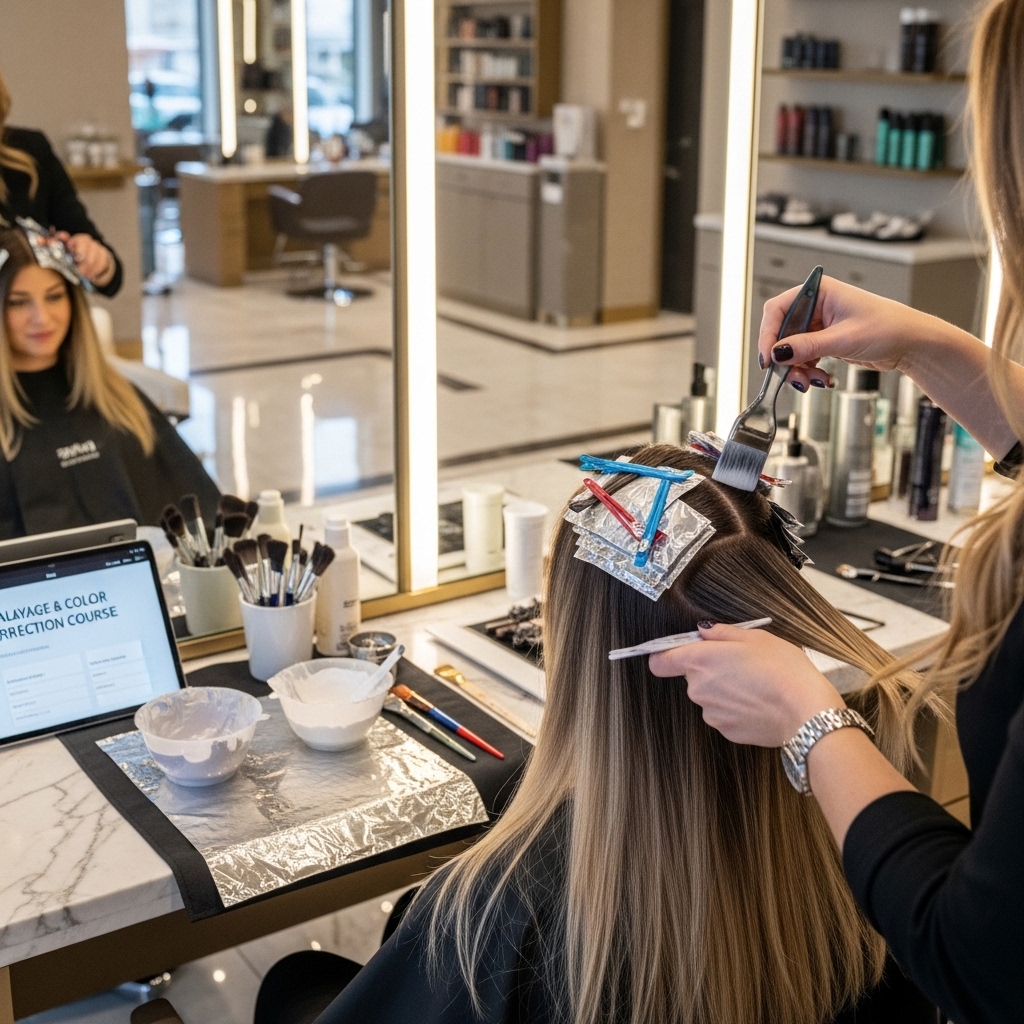
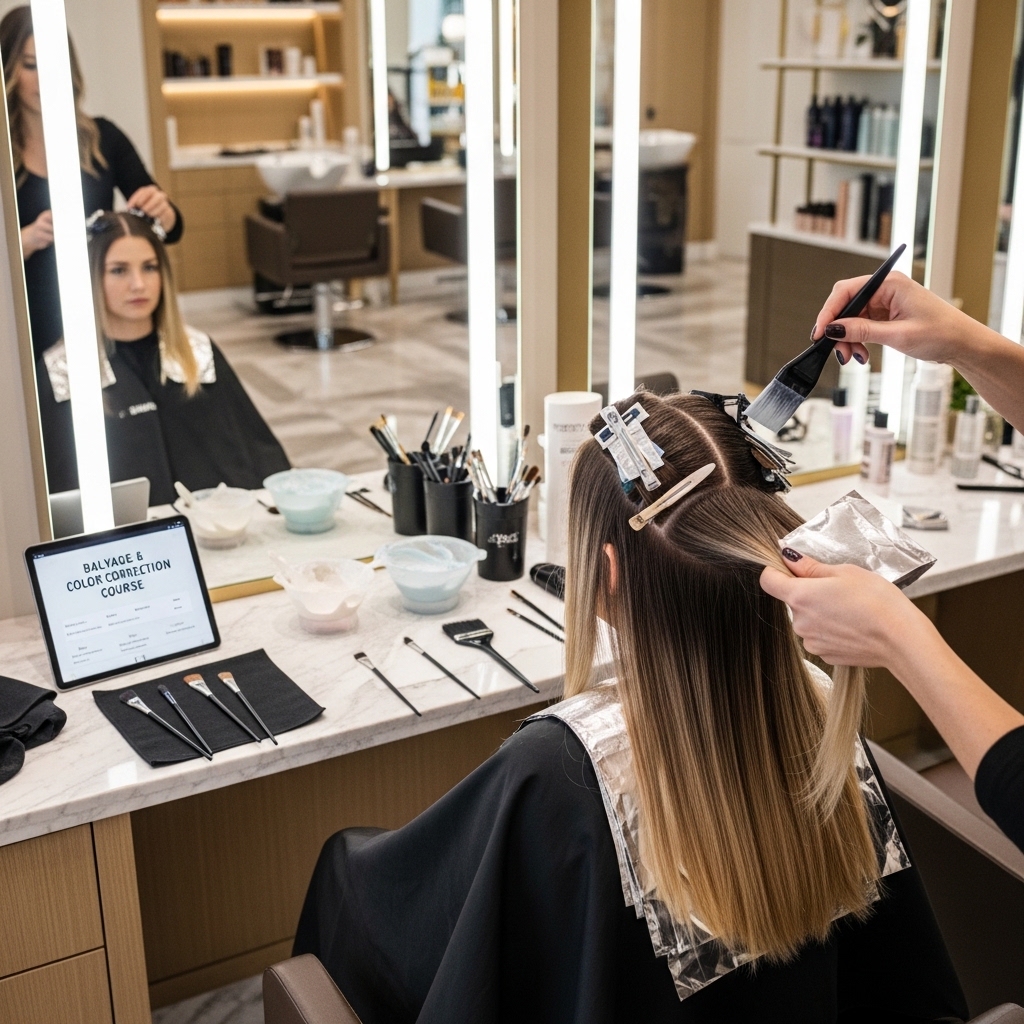
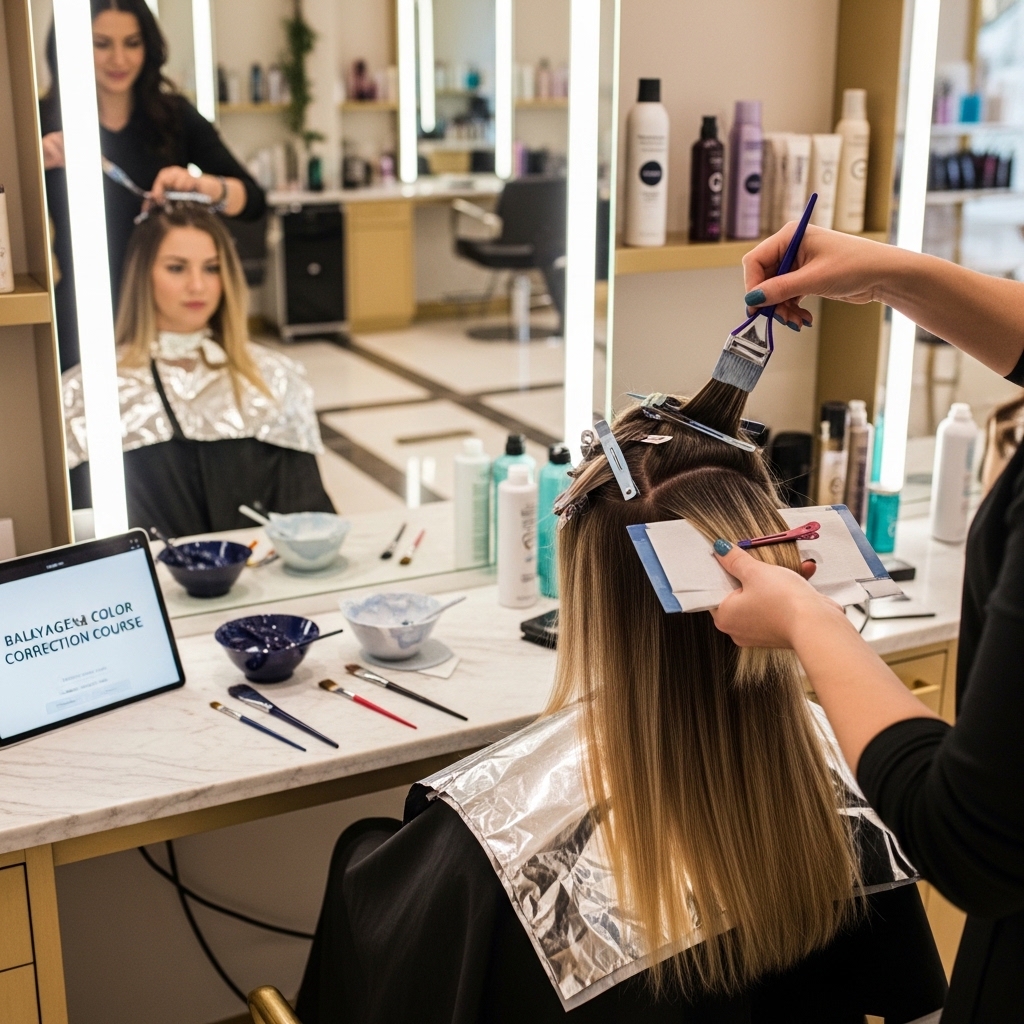
Color Correction and Balayage Digital Course
The Advanced Technical Training Program for Colourists Who Want to Master the Diagnosis, Planning, and Execution of Complex Colour Services
Colour correction is the service that most colourists are afraid of.
Not because they lack skill — because they lack the diagnostic system that takes the guesswork out of it. The client who arrives with years of accumulated box colour on their hair, the client whose previous bleach application has created uneven porosity across the lengths, the client with a dark-to-light target that requires multiple sessions and a planned approach — these are not impossible situations. They are situations that require a structured diagnostic process, a precisely planned technical approach, and the technical knowledge to execute each stage without creating a bigger problem than the one being addressed.
The colourist who has that system takes on colour corrections confidently, prices them appropriately, manages the client’s expectations with authority, and delivers results that generate the most shareable, most referred content in the salon’s portfolio. The colourist without that system turns colour corrections away, underprices the ones they take, and holds their breath through every bleach application hoping it goes the way they expect.
The Li-Bar Color Correction and Balayage Digital Course is the complete technical curriculum — from the chemistry of colour to the execution of advanced techniques — that builds the confident, systematic colourist.
📥 Li-Bar digital download. Instant access.
THE COURSE — MODULE BY MODULE
MODULE ONE: THE SCIENCE OF COLOUR
Hair Pigment and Colour Chemistry
The foundation that makes every subsequent technical decision logical rather than intuitive: the understanding of natural pigment, artificial pigment, and how colour formulations interact with both.
Natural hair pigment: Melanin — the two types (eumelanin, which produces black and brown, and phaeomelanin, which produces red and yellow) and their distribution across the natural hair colour levels (the shade depth scale from 1 through 10, the pigment composition at each level, and the clinical implications for colour planning). The colourist who understands that a level 4 natural hair contains a higher concentration of red and orange pigment than a level 6, and that lightening through these levels will produce those warm tones before neutral or cool can be achieved, can plan and communicate the session timeline that is actually required to reach the target result — rather than promising something on the first session that requires three.
How oxidative colour works: The chemistry of the oxidation process — the role of hydrogen peroxide at different volumes (6, 9, 12, 30, 40 volume and their specific applications), the lifting capacity of each volume, the development time and the factors that affect it (the natural heat of the scalp versus the mid-lengths versus the ends — the heat gradient that produces colour bands in carelessly applied colour), and the colour’s relationship with existing pigment during the oxidation process.
The porosity factor: The single variable most responsible for unpredictable colour results and the variable most often unmeasured before a service begins. The porosity assessment methodology (the tactile and visual assessment, the water absorption test), the porosity types (low porosity — resistant, slow processing; medium porosity — the ideal processing state; high porosity — fast processing, rapid fade, uneven uptake), and the formula adjustments required for each porosity type. The porosity-correcting pre-treatment options and when each is appropriate. 🔬
The Colour Level and Tone System
The complete level (depth) and tone (reflect) system used in professional colour formulation: the level scale, the international colour coding system, the reflect categories and their letter codes, the reading of colour formulas on product boxes, and the mixing system for achieving target results from the available product range. The foundation that makes colour formulation systematic — the colourist who understands the level and tone system can formulate a colour to achieve any target from any starting point.
MODULE TWO: THE COLOUR CORRECTION DIAGNOSTIC SYSTEM
The Consultation and Analysis Protocol
The structured consultation for a colour correction client: the complete history (every colour service performed in the past two years, including the home colour applications the client is often reluctant to disclose fully and the strategies for eliciting accurate information), the porosity assessment across the entire hair shaft (the porosity difference between roots, mid-lengths, and ends is common in colour-compromised hair and must be assessed at each section), the integrity assessment (the hair’s ability to withstand further chemical service — the elasticity test, the visual assessment of condition, and the breaking-point identification), and the target assessment (the precise target colour defined visually with reference images — not “lighter” but the specific level and tone the client is trying to achieve, discussed within the context of what is achievable from the starting point in the available session time).
The Colour Diagnosis Matrix
The systematic assessment tool that takes the starting point, the history, and the target and produces the technical plan: the correction category identification (the service is a lift-and-tone correction, a colour-removal correction, a colour build-up removal, or a tonal correction — each requires a fundamentally different technical approach), the session plan (the stages required to move from the current state to the target, with the realistic timeline for each), and the expectation management framework (the specific language for communicating the session plan to the client — what will be achieved today, what will require a subsequent appointment, what the end result will look like when the plan is complete). 💇♀️
The Technical Correction Approaches
For each correction category, the complete technical approach:
Lift and tone corrections: The client who has colour that is too dark and needs to be lifted. The pre-lightening approach (the bleach application methodology, the product selection, the developer volume selection by zone, and the timing management across different porosity and depth zones), the toning application after lift (the timing, the formula calculation, the application technique for even tonal result across lifted hair), and the condition restoration protocol at every stage.
Colour removal corrections: The client whose artificial pigment needs to be removed without the lifting action of bleach. The colour remover chemistry, the application protocol, the oxidation aftercare requirement that most colourists skip and that causes the colour to reoxidize to a dark tone if omitted, and the toning and colour application that follows removal.
Colour build-up corrections: The client with multiple layers of accumulated colour (particularly dark shades) that have resulted in flat, dense, unnatural depth. The progressive approach that safely reduces the depth without compromising hair integrity, the session limits based on the integrity assessment, and the maintenance plan that prevents future build-up.
Tonal corrections: The client whose colour tone is wrong — the brassy blonde, the green-tinted grey, the too-warm brunette. The tonal correction formula approach, the colour wheel application (the complementary colour that neutralizes each unwanted tone), and the maintenance product recommendations that extend the tonal result between appointments.
MODULE THREE: BALAYAGE MASTERY
The Balayage Philosophy and Technique Foundation
Balayage is not a technique — it is a result. The sweeping, sun-kissed, gradient colour result that the technique is named for requires understanding the placement logic before the application technique. The colourist who places balayage correctly — in the positions where sunlight would naturally land on the hair, at the densities that produce the lived-in, organic look rather than the painted-stripe look — can produce the result with any placement method. The colourist who applies the technique correctly but places it incorrectly produces a result that looks like streaks rather than sunlight.
The Placement Logic
The placement principles for each hair type, face shape, and lifestyle context:
The face-framing principle: The pieces placed around the face to brighten the complexion and frame the face shape — the placement positions for different face shapes (the round face that benefits from length-forward placement versus the angular face that benefits from softness around the hairline), and the heaviness calibration (the piece size that looks natural versus the piece size that looks intentional in a way that conflicts with the balayage aesthetic).
The distribution pattern: The diagonal-back sections and the panel-by-panel distribution that ensures the colour is present throughout the style in a balanced way — not concentrated at the back, not absent at the sides, not creating a visible line of demarcation at the parting.
The point-of-application calibration: The starting point of the colour on each section — the position on the length that produces a root-to-ends diffusion versus a mid-length-to-ends placement, and the reasoning for choosing each based on the target result and the maintenance commitment the client can sustain. 🎨
The Application Techniques
Three application methods with the technical instruction, the tool selection, and the appropriate use case for each:
The classic balayage sweep: The freehand technique using a paddle brush — the board placement, the product loading technique, the sweep motion that deposits maximum product at the point of application and feathers to transparency at the root end, and the saturation check.
The foilayage technique: The balayage application placed into an open foil — the hybrid technique that provides more lift than classic open-air balayage while maintaining the freehand placement aesthetic. The foil placement, the sealing technique, and the processing monitoring.
The root-shadow balayage: The complete technique for the balayage with an intentional root shadow — the darker root application that creates depth and reduces the visual grow-out line, the shadow formula calculation, and the blending technique at the shadow-to-balayage transition zone.
MODULE FOUR: THE COLOUR CONSULTATION AND COMMERCIAL SKILLS
The Colour Consultation Business Framework
The commercial architecture of colour services: the pricing model for variable-cost services (the consultation fee for colour corrections that establishes the service’s professional value and covers the consultation time), the time and product cost estimation for complex services (the pricing approach that accounts for actual session time and product usage rather than applying a standard service price to a non-standard service), and the multiple-session communication (the consultation conversation that establishes the session plan, the total investment across all sessions, and the timeline — the communication that converts a consultation into a committed multi-session client). 💰
The Colour Correction Risk Assessment and Liability Communication
The professional risk assessment for any service with significant integrity risk: the integrity threshold (the assessment of the hair’s condition against the minimum required for the planned service), the “cannot proceed” decision and the communication language for declining a service that the hair cannot safely support, the liability release process for services with acknowledged risk, and the documentation standard for the consultation record.
📂 COMPLETE LI-BAR FILE SUITE
🔬 Complete Course PDF — all four modules (A4 and US Letter, extensively illustrated) | 📊 Colour Correction Diagnostic Matrix Tool (editable) | 💇♀️ Consultation Record Template for Colour Clients (editable) | 🎨 Balayage Placement Diagram Library — face shapes and hair types (PDF) | 💰 Colour Service Pricing Calculator — time and product cost model (Excel + Google Sheets) | ✅ Pre-Service Integrity Assessment Checklist (editable) | 📋 Client Session Plan and Expectation Setting Template (editable)
Reviews
There are no reviews yet.