
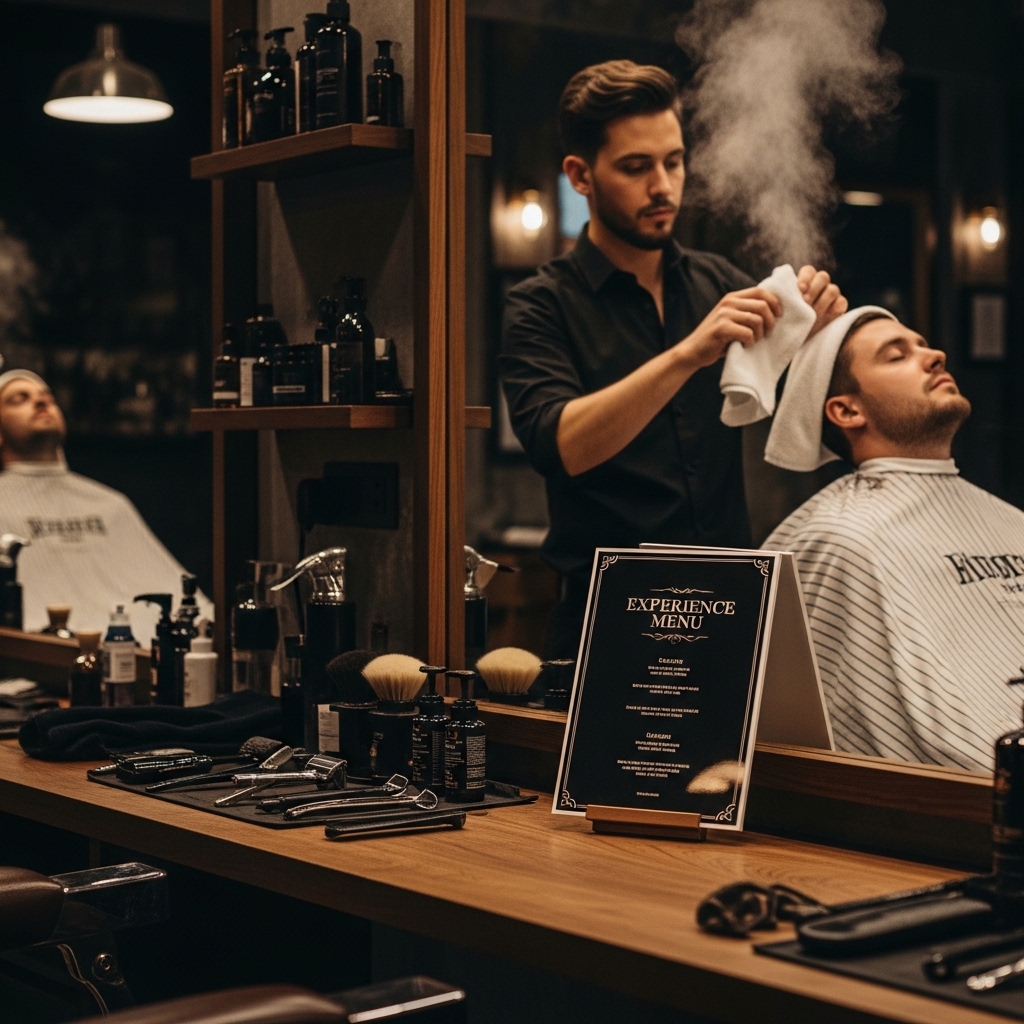
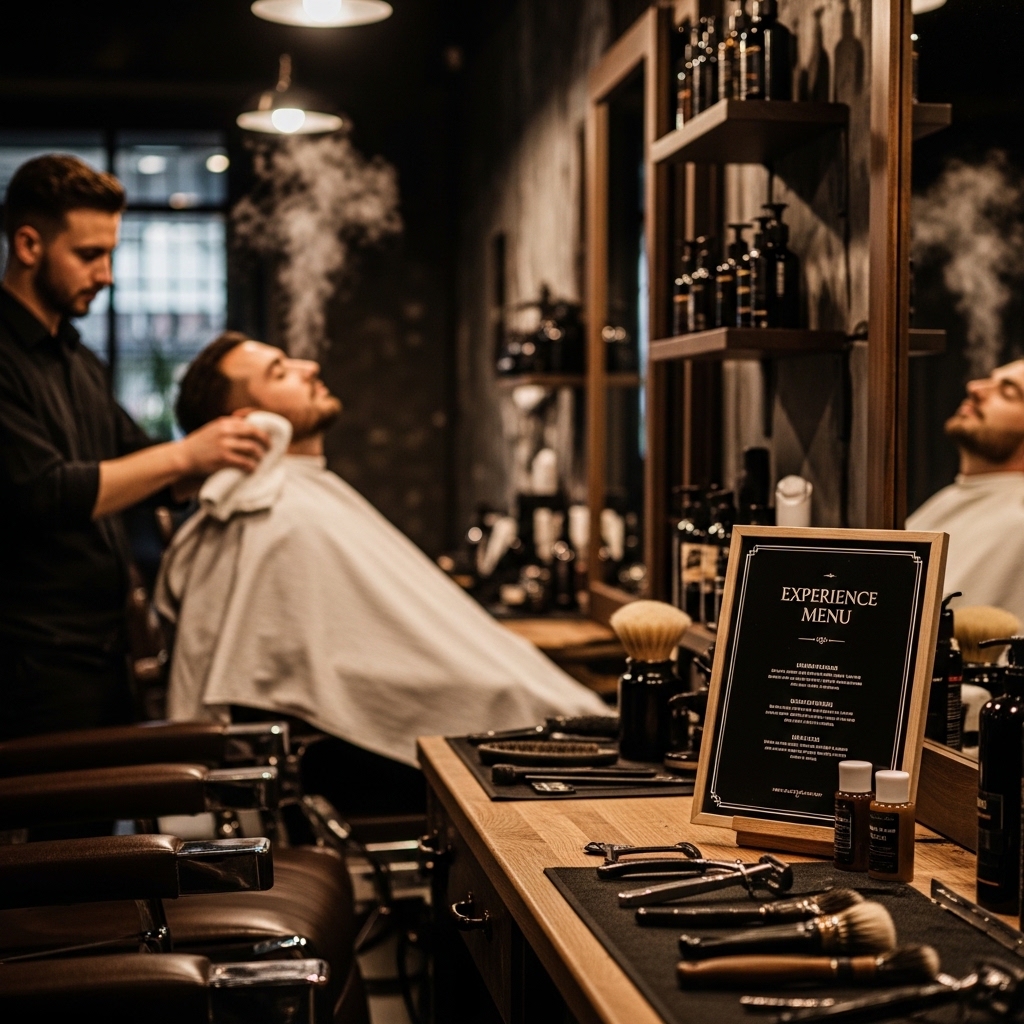
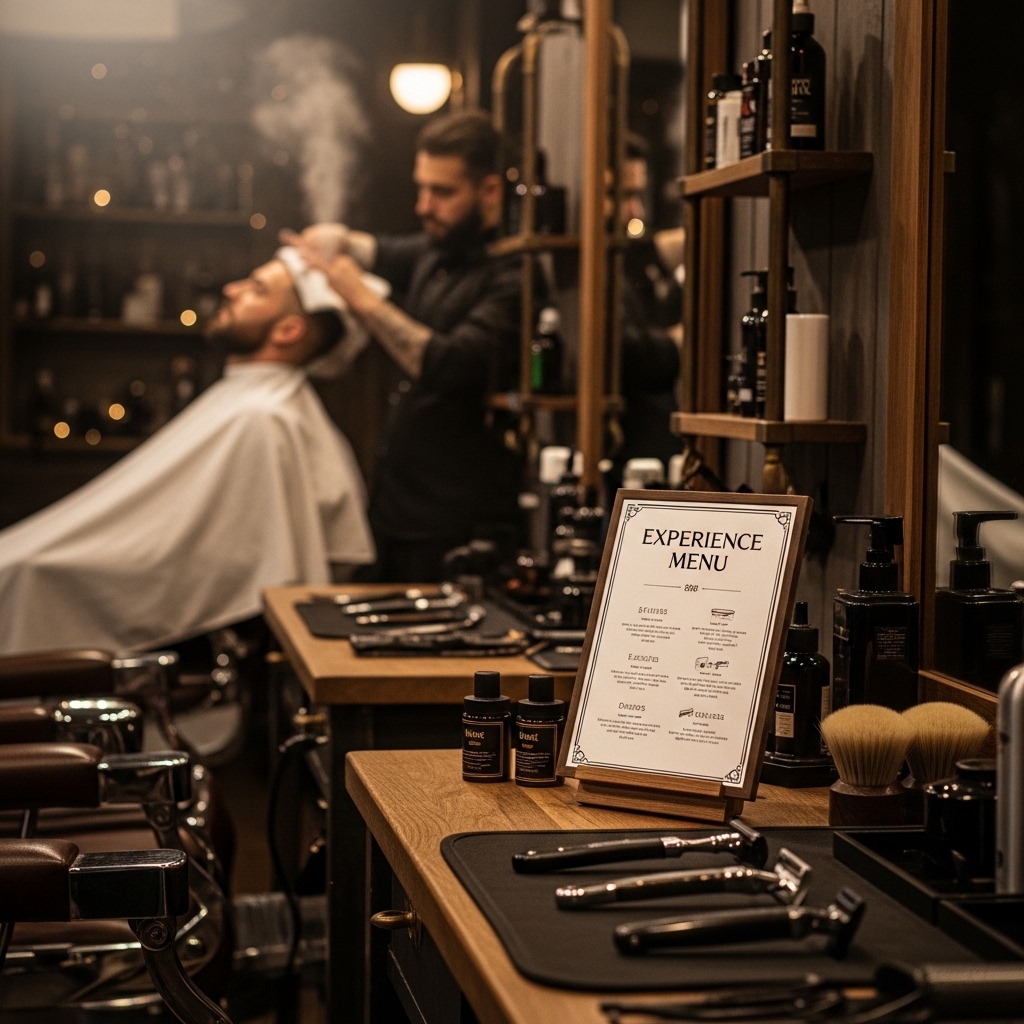
Barbershop Experience Menu Blueprint
The Complete Design System for a Barbershop Service Menu That Communicates Premium Value, Sets Clear Expectations, and Guides Every Client Toward the Right Booking
Most barbershop menus are price lists.
Name of service on the left. Price on the right. Sometimes a short description that says “includes shampoo and blow-dry” or “beard trim with hot towel.” The menu answers the question “how much?” and nothing else.
The menu that builds a premium barbershop brand does something more ambitious. It communicates the craft behind the service. It distinguishes between service tiers in a way that makes the upgrade feel natural rather than upmarket. It uses language that makes the client feel they are choosing an experience rather than purchasing a commodity. It organizes services in a way that guides the client toward the right choice rather than leaving them to make a random selection from a list they do not fully understand.
The difference between a price list and an experience menu is the difference between a client who books the cheapest option without understanding what they are choosing and a client who chooses the tier that is right for their needs, understands what it includes, and feels confident in their choice before they arrive.
The Li-Bar Barbershop Experience Menu Blueprint is the complete design system — the copywriting framework, the service architecture, the pricing psychology, and the visual design guide — for building the second kind of menu.
📥 Li-Bar digital exclusive. Instant download.
THE BLUEPRINT — SECTION BY SECTION
SECTION ONE: THE SERVICE ARCHITECTURE
The Service Tier Framework
The foundational architecture of a premium barbershop menu: the tier system that allows clients at different investment levels to be served excellently without creating a confusing or overwhelming list.
The three-tier barbershop service architecture:
Tier One — The Signature Service: The core service that the majority of clients book most frequently. The haircut or shave at the standard that represents the barbershop’s baseline quality. The name that communicates the service without using generic language — not “Men’s Haircut” but a name specific to the barbershop’s identity. The description that communicates what is included (the consultation, the cut technique, the product finish, the time allocation), what differentiates it from a budget alternative, and the result the client can expect.
Tier Two — The Premium Service: The elevated version of the core service — the additional time, the additional technique, the additional experience element (the hot towel treatment, the scalp massage, the beard line-up included, the premium product use) that justifies a higher price point through genuine additional value rather than arbitrary markup. The tier that a client self-selects into when they understand what it includes — and the upgrade conversation script that the barber uses when a client’s needs suggest the premium tier is more appropriate than the standard.
Tier Three — The Experience Service: The highest investment tier — the complete experience package, the occasion service, the service for the client who wants the full traditional barbershop treatment. The description that conveys luxury and thoroughness without being pretentious. The service that clients book for first haircuts, special occasions, and gift purchases — and therefore the tier that benefits most from gift card promotion and special occasion marketing.
The Add-On Architecture
The menu structure for add-on services: the design principle that add-ons are presented as enhancements to an experience the client is already committed to rather than as additional items to purchase. The add-on language guide: the description of each add-on that explains what it does and why the client might want it at this visit — the hot towel finish (“the traditional close to your service — the heat opens every pore, the towel removes every trace of product, the aftercare balm closes and conditions the skin”), the beard shaping included with a cut (“the finishing detail that takes the haircut from excellent to complete”), the scalp treatment. 💈
The Barbershop-Specific Service Copywriting Guide
The language principles for writing barbershop service descriptions that communicate craft and premium value:
Use technical language selectively: The barber’s vocabulary — the fade technique names, the blade numbers, the taper terminology — communicates expertise when used appropriately and creates confusion when used without context. The guide for introducing technical language in service descriptions in a way that educates rather than alienates.
Describe the outcome, not the process: “A clean, sharp line-up that frames the face and gives the haircut its structure” communicates more value to a client than “edge-up around the hairline and neckline.” Both describe the same service; one sells it.
Communicate the tactile experience: The barbershop service is not just a haircut — it is the experience of being cared for with skilled, attentive hands. The description that evokes the warmth of the hot towel, the precision of the straight razor, and the finishing detail of the cold towel close communicates an experience that no budget alternative can replicate, and justifies the price point before the client arrives.
SECTION TWO: THE PRICING PSYCHOLOGY FRAMEWORK
The Price Architecture Principles
The pricing decisions that communicate premium positioning: the odd-number versus round-number pricing decision (the data on which communicates more premium in the service industry context and the reasoning behind it), the tier gap sizing (the price differential between tiers that feels like a meaningful upgrade rather than an arbitrary surcharge), and the anchor pricing effect (the premium tier price that makes the standard tier price feel accessible by comparison — the psychological mechanism that drives tier selection).
The Pricing Communication Guide
The language around pricing that maintains premium positioning: the price display format (the decision on whether to list prices prominently on the menu or to present the investment in a way that de-emphasizes the number relative to the value), the conversation about pricing at booking (the language that presents the investment confidently without apologizing for it), and the price increase communication framework (the language for communicating a service price increase to existing clients in a way that acknowledges the change and frames it within the context of the quality and experience they receive). 💰
SECTION THREE: THE VISUAL DESIGN GUIDE
The Menu Format Options
The physical and digital menu formats appropriate for different barbershop environments: the wall-mounted menu (the permanent display that communicates the service offering to walk-in clients and sets the atmosphere of the space), the counter or station card (the close-proximity version for client reference during consultation), the booking page menu (the digital version optimized for the online booking experience), and the social media menu post (the shareable format that announces services and pricing to the broader audience).
For each format: the recommended dimensions, the typography principles (the font choices that communicate the barbershop’s positioning — the serif that communicates tradition, the geometric sans-serif that communicates modern precision, the custom or hand-lettered element that communicates craft), the hierarchy (the visual weight assigned to the service name versus the description versus the price), and the visual element guidelines (the use of photography, illustration, or graphic elements that reinforce the barbershop’s visual brand).
The Canva Design Templates
The ready-to-customize menu layout templates: three visual directions covering the traditional/classic barbershop aesthetic, the modern minimal barbershop aesthetic, and the urban premium barbershop aesthetic. Each template includes all format variations and is fully editable with the salon’s colors, fonts, and service content. 🎨
SECTION FOUR: THE MENU AS A SALES TOOL
The Consultation-to-Menu Connection
The training guide for using the menu as an active part of the client consultation rather than a passive reference document: the menu walk-through technique (guiding a new client through the service options during the consultation to ensure they understand what is available and select the service most appropriate for their needs), the upgrade conversation (the natural, non-pressured introduction of the higher tier during a consultation where the client’s needs suggest the upgrade would serve them better), and the add-on suggestion timing (the specific point in the consultation where add-on suggestions are most likely to be received positively).
The Menu Review Protocol
The regular review process for keeping the menu current, accurate, and commercially optimized: the quarterly review (the assessment of which services are selling, which are underperforming, and whether the service list reflects the current skills and interests of the team), the annual pricing review (the annual assessment of pricing against market rates and internal cost changes), and the seasonal menu additions (the limited-time additions for seasonal services that create urgency and content opportunities without permanently expanding the service menu). 📋
📂 COMPLETE LI-BAR FILE SUITE
💈 Complete Barbershop Experience Menu Blueprint PDF | 📝 Service Description Copywriting Framework with examples (PDF) | 💰 Pricing Architecture Guide and price tier calculator (editable) | 🎨 Three Canva Menu Design Templates — traditional, modern, urban premium | 📱 Social Media Menu Post Template (Canva) | ✅ Menu Review Protocol Checklist (editable) | 💬 Consultation-to-Menu Sales Script Guide (PDF)
Reviews
There are no reviews yet.