
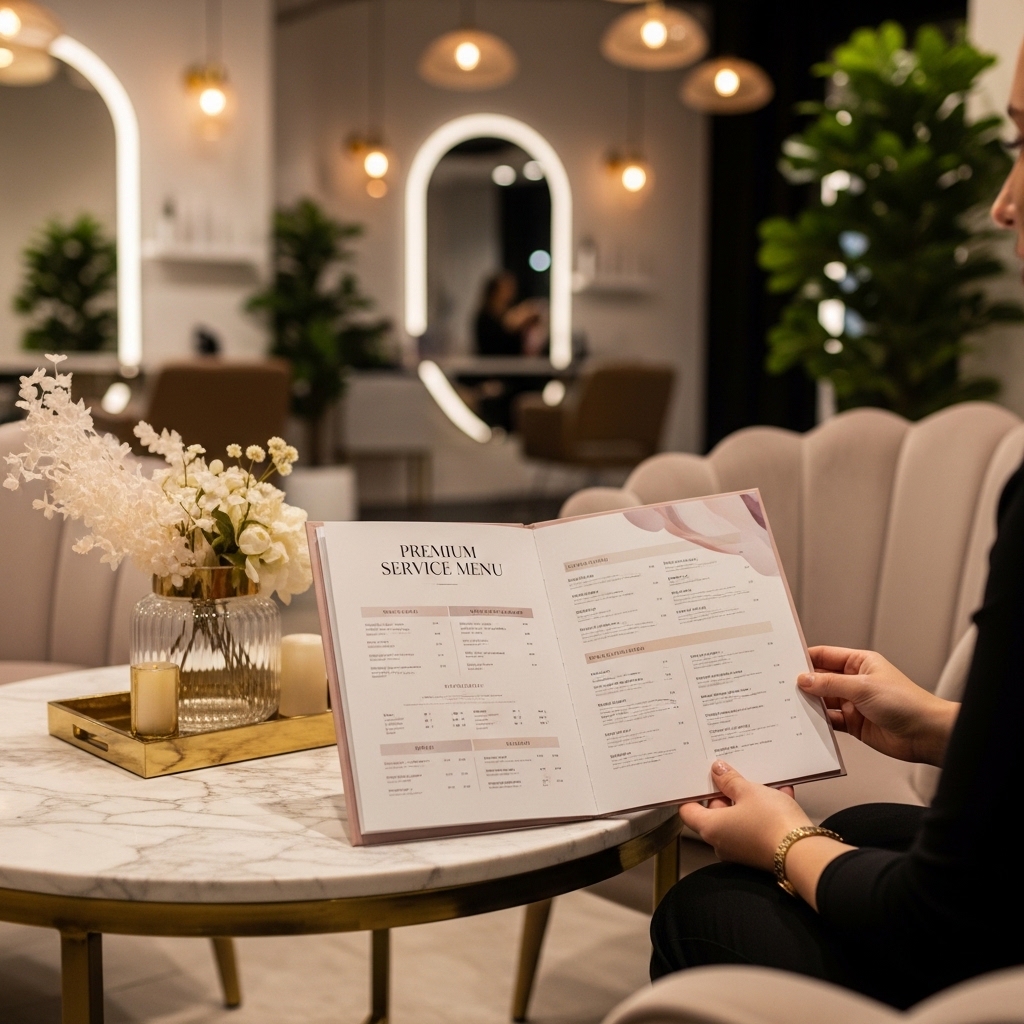
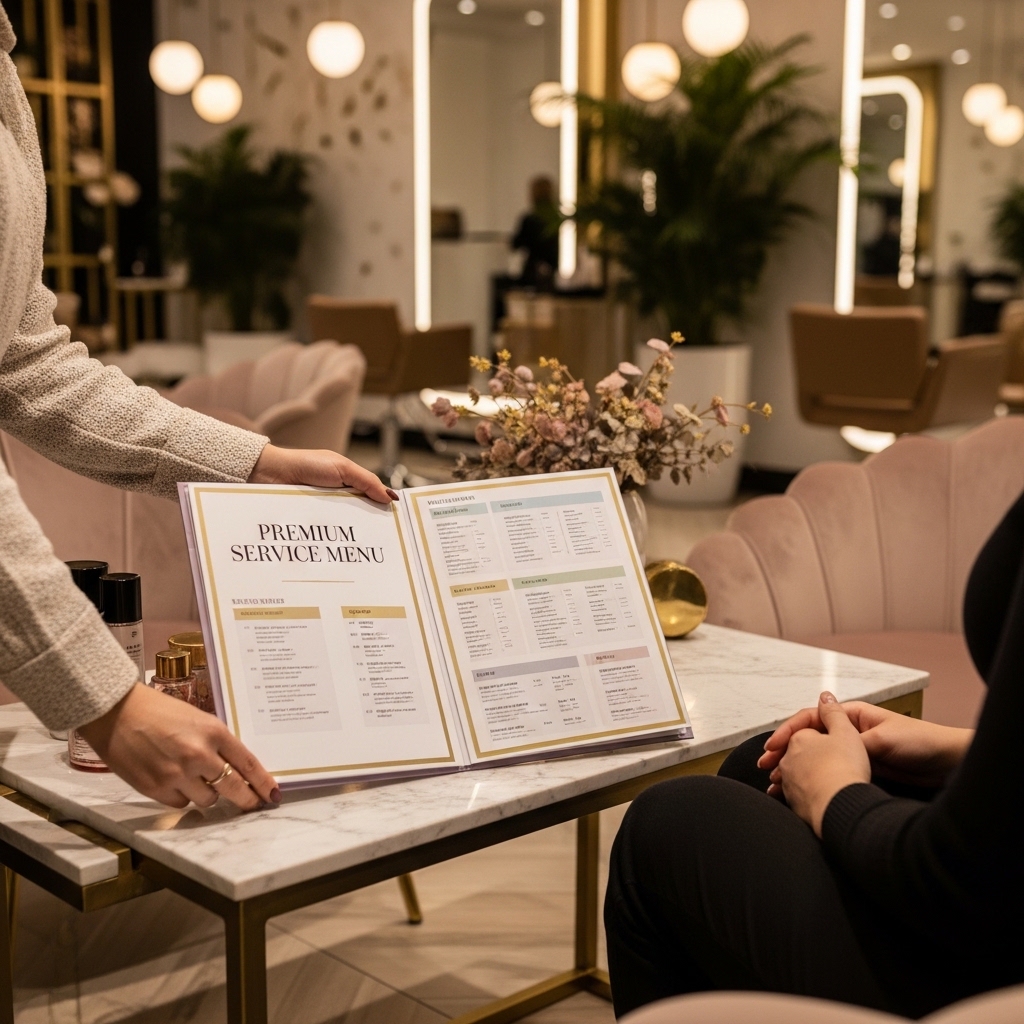
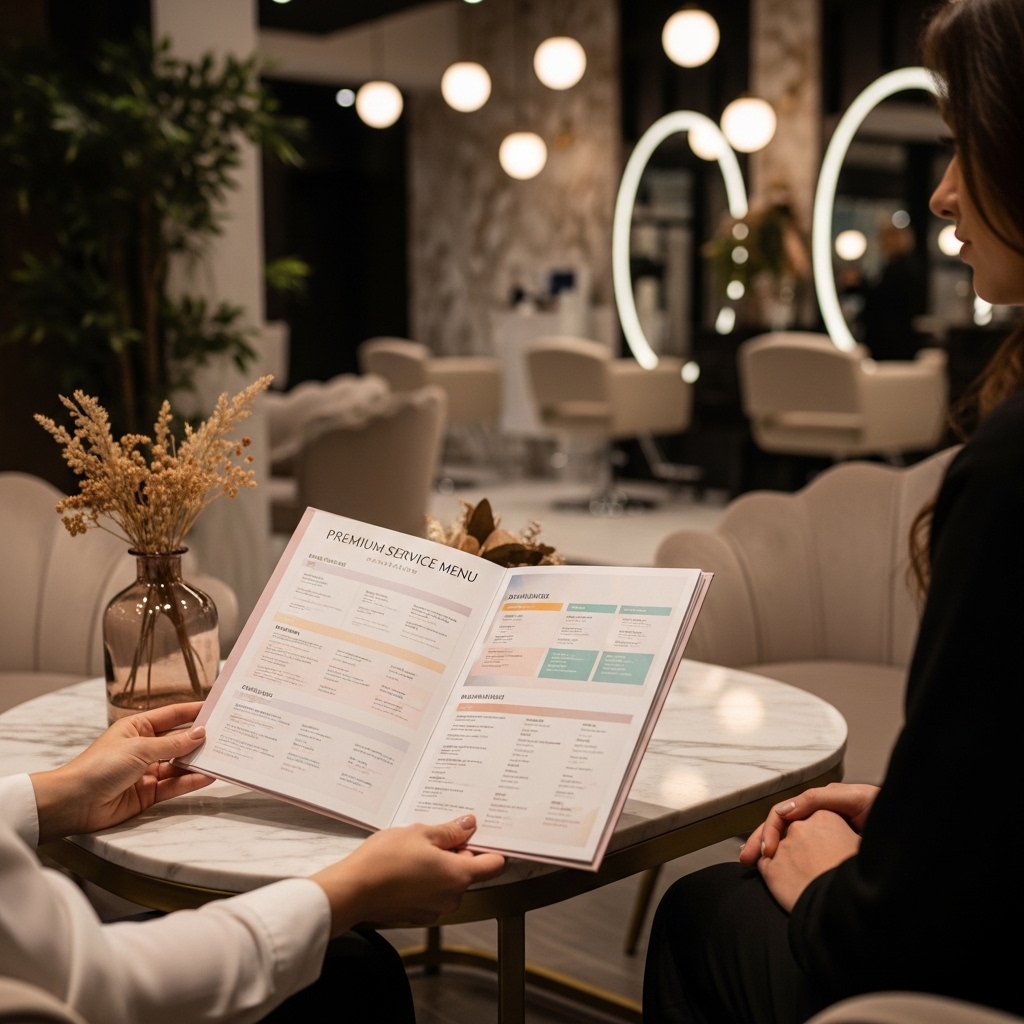
Premium Salon Service Menu Blueprint
The Strategic Design, Copywriting, and Pricing System for a Full-Service Salon Menu That Reflects Your Quality and Commands the Investment It Deserves
There is a version of your salon’s service menu that loses you money every month.
It is the version with prices set to be competitive three years ago that have not been reviewed since. The version with service names that describe the action but not the experience — “Cut and Blow-Dry” instead of something that communicates what the client actually receives. The version without a clearly organized tier system, so clients default to the cheapest option without understanding what they are missing. The version without package options, so clients who would happily invest more for a combined service never know that combined service exists.
The menu is not a neutral document. It is actively determining the average transaction value in your salon — the average amount every client spends — every day it is in use. A poorly constructed menu produces a lower average transaction value than the quality of your services justifies. A strategically constructed menu guides clients toward the services that serve them best and generates the revenue that sustains and grows the business.
The Li-Bar Premium Salon Service Menu Blueprint is the redesign system — from architecture through language through pricing through design — for the menu that serves both your clients and your business correctly.
📥 Li-Bar digital exclusive. Instant download.
THE BLUEPRINT — IN FULL DETAIL
SECTION ONE: THE SALON SERVICE ARCHITECTURE
The Service Categorization Framework
The organization of salon services into a structure that guides the client through the menu intuitively: the primary service categories (the hair services — cut, colour, and treatments — organized in the sequence a client naturally thinks about their service, not alphabetically or by price), the secondary service categories (the beauty services, the nail services, the beauty treatments if applicable), and the package and combination services (the bundled offerings that increase average transaction value while providing genuine client value through the convenience and saving of combined booking).
The menu architecture design principles:
Lead with the client’s need, not the salon’s offer: The menu organized around what the client wants (“I want new colour” before “I want a cut”) performs better than the menu organized around the salon’s capabilities. The client navigating the menu is asking “which of these is for me?” — the architecture that answers that question most directly generates more appropriate bookings and fewer consultation-stage redirections.
Create a natural upgrade path: Every service category should have at least two tiers — the entry-level service and the premium version — with the premium version clearly communicating the additional value in terms of time, technique, product quality, or result. The client who understands the difference between the standard colour service and the premium colour service is able to make an informed choice; the client who sees two price points without understanding the distinction defaults to the lower price.
Balance breadth with clarity: The menu with forty-seven individually named services overwhelms. The menu with eight clearly defined service categories with options within each informs. The architecture that makes every client feel they can find their service in under two minutes.
The Full-Service Salon Service Description Template Library
The copywriting templates and examples for every major salon service category:
Haircut and styling services: The description framework that communicates the consultation depth, the technique quality, the styling finish, and the duration — the four elements that distinguish a premium haircut service from a commodity one. The template for the women’s cut description, the men’s grooming cut description, the children’s cut description, and the cutting-only versus blow-dry-included description.
Colour services: The most technically complex menu category and the most frequently under-described. The framework for describing colour services that communicates the technique without requiring the client to be a colour expert. The description approach for: the full head colour, the partial colour, the balayage and freehand techniques, the highlights in foil, the glossing and toning service, and the colour correction service (the service most needing careful menu description because the pricing is variable and the client expectation management is critical). 💫
Treatment and conditioning services: The description framework for services whose value is felt rather than seen — the bond-building treatment, the deep conditioning service, the scalp treatment, the smoothing and keratin service. The language that communicates the tangible benefit the client will experience rather than the ingredient list.
The package and combination services: The description approach for bundled services that makes the combined value clear: the Colour and Cut Package, the Treatment and Style Service, the seasonal or promotional combination service. The formula for communicating the saving or convenience the package provides in a way that makes the choice feel rewarding rather than manipulated.
SECTION TWO: THE PRICING STRATEGY GUIDE
The Cost-Based and Value-Based Pricing Analysis
The dual-lens pricing methodology: the cost floor (the calculation of the minimum price required to cover the direct cost of each service — the product cost, the time cost at the target hourly rate, and the allocated overhead) and the value ceiling (the maximum the target client would rationally pay for the service given what it delivers and what alternatives cost). The pricing that sits between these two points is commercially rational; the pricing decision within that range is a brand and positioning decision.
The Salon Pricing Communication Guide
The menu presentation of prices in a way that maintains premium positioning: the visual treatment of price information (the size, placement, and format of price information relative to service information — the menu where price dominates communicates a commodity; the menu where the service communicates first and price confirms creates a different decision-making context), the variable pricing communication (the “from” price for services with inherent variability — colour corrections, long hair supplements — presented in a way that is transparent without being alarming), and the consultation pricing policy (whether a consultation fee is charged and if so how it is described). 💰
SECTION THREE: THE VISUAL DESIGN SYSTEM
The Salon Menu Visual Design Principles
The design standards for a full-service salon menu that communicates the salon’s quality level in its visual presentation:
Typography hierarchy: The font system for service category headers, service names, descriptions, and prices — the visual hierarchy that guides the eye through the menu in the intended sequence and communicates the relative importance of each element. The maximum of three font styles (one for headers, one for body, one accent) — the design constraint that produces elegance rather than visual noise.
White space and density: The premium salon menu uses more white space than its budget equivalent. The density of information on the page communicates the price point — the dense, compact menu signals budget; the open, spacious layout signals premium. The white space guide for each menu format.
Color application: The brand color application in the service menu — the accent colors, the category divider colors, and the background treatment for featured or signature services. The guide for maintaining menu visual cohesion with the broader salon brand palette.
Photography integration: The decision on whether to include photography in the service menu (the arguments for and against, the resolution standards for menu printing), and the specific photography types that communicate best in the menu context (the detail shot and the atmosphere shot rather than the before-and-after, which is more effective in digital channels than print menus).
The Four Menu Format Templates
The Printed Desk Card: The folded, table-top menu card for the styling station — the format the client reads during the consultation, sized to be held comfortably and organized so the most relevant sections are visible without unfolding.
The Framed Wall Menu: The wall-mounted service and price display — the format that communicates the full offering to waiting clients and walk-in visitors. The sizing guide for different salon spaces.
The Digital Booking Page Menu: The menu optimized for the booking platform — organized by the decision flow a booking client follows (what service first, then what tier, then what add-ons) rather than by the salon’s internal category organization.
The Social Media Menu Card: The shareable, single-service or service-category graphic for Instagram and Facebook — the format for announcing new services, seasonal offerings, or promotional pricing. The template that maintains brand consistency across the social media presence. 🎨
SECTION FOUR: THE MENU PERFORMANCE SYSTEM
The Menu Analytics Framework
The data-based approach to menu optimization: the service booking distribution analysis (which services are booked most and least frequently, and whether the distribution reflects the salon’s strategic priorities), the average transaction value tracking (the monthly average of total service revenue divided by service appointments — the KPI most directly influenced by menu design), and the upgrade and add-on conversion rate (the percentage of bookings that include an add-on or an upgraded tier — the metric that measures how well the menu is doing its commercial job).
The quarterly menu review: the structured review of the analytics data, the identification of underperforming services (the services with low booking rates that may require description improvement, repositioning, or removal from the menu), and the identification of upgrade opportunities (the service tiers or add-ons that are underperforming relative to the quality they provide, suggesting a communication rather than a service problem). 📊
📂 COMPLETE LI-BAR FILE SUITE
🌟 Complete Premium Salon Menu Blueprint PDF | 📝 Service Description Template Library — all service categories (editable) | 💰 Service Pricing Analysis Worksheet — cost floor and value ceiling calculator (Excel + Google Sheets) | 🎨 Four Menu Design Templates — desk card, wall menu, digital, social (Canva) | 📊 Menu Performance Analytics Dashboard (Excel + Google Sheets) | ✅ Menu Review Protocol and Quarterly Checklist (editable) | 💬 Upgrade Conversation Script Guide for Stylists (PDF)

Reviews
There are no reviews yet.