
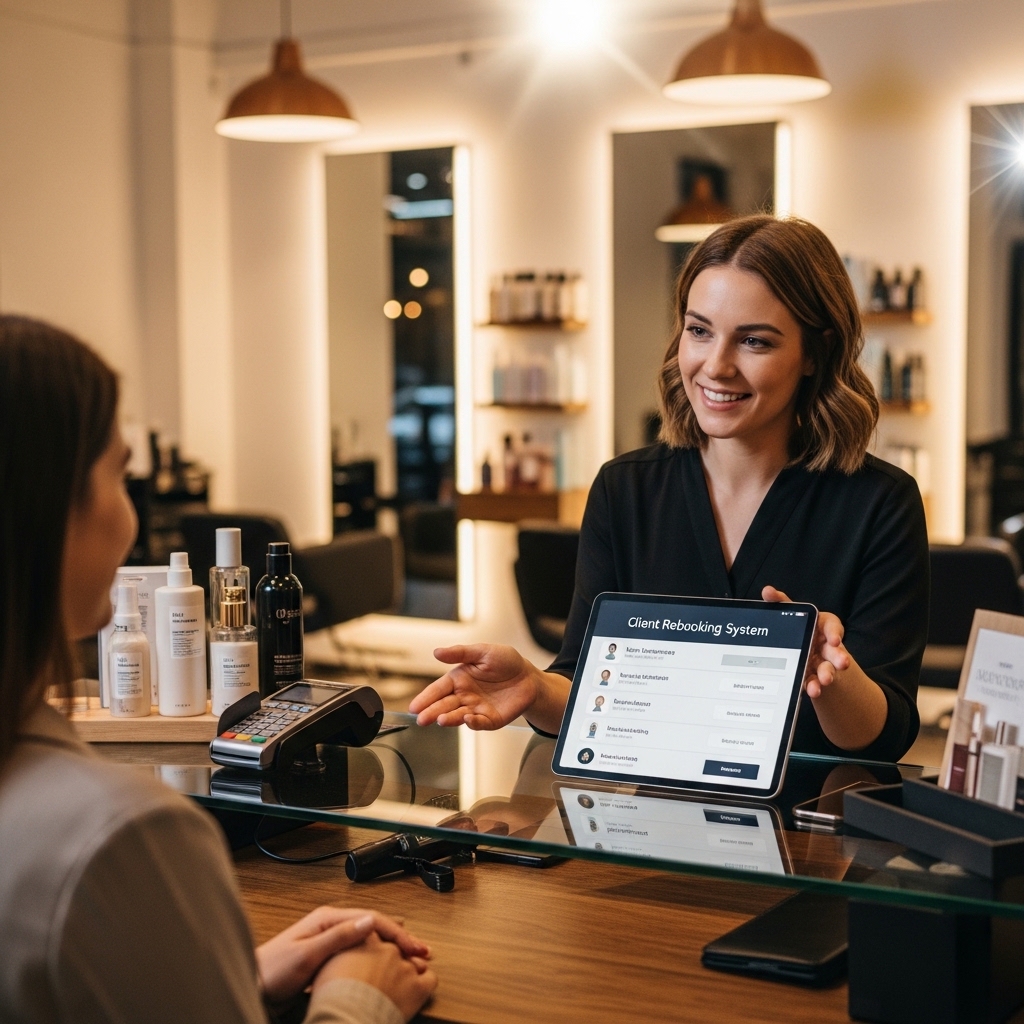
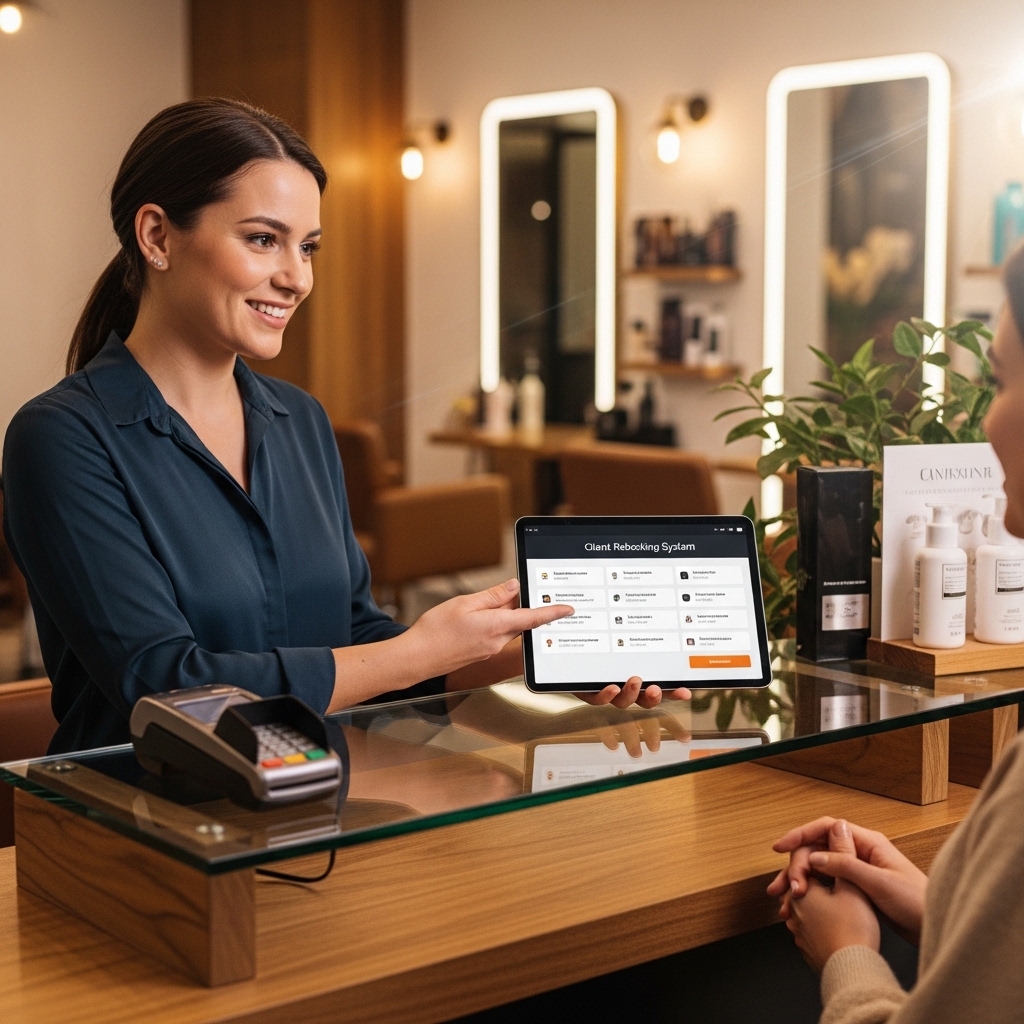
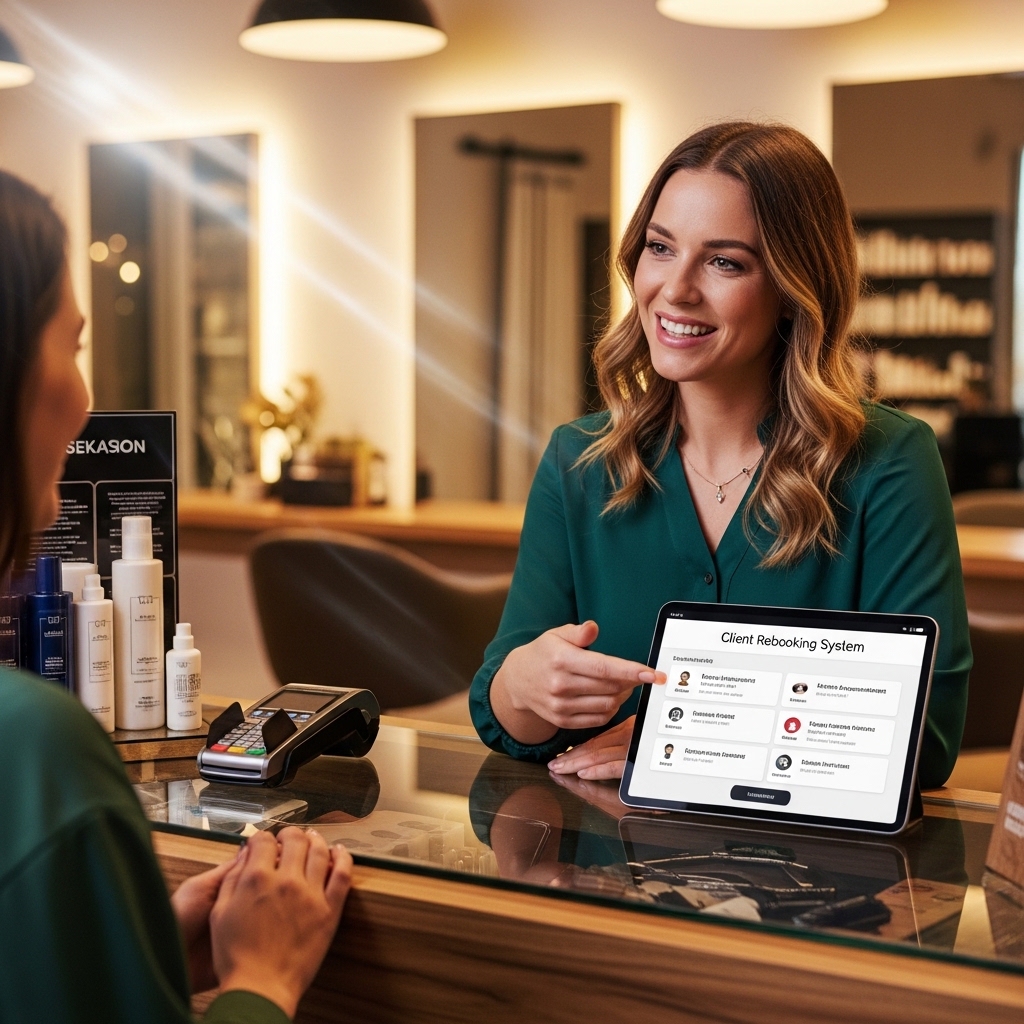
Client Rebooking and Retention System
The Complete Revenue Protection System for Salons and Barbershops That Want Every Client to Rebook Before They Leave — Every Time
Every client who leaves without a next appointment is a client you might lose.
Not certainly. But possibly. Between the day they leave and the day they need their next appointment, twelve things will happen: they will walk past a different salon and notice the window display, their friend will recommend somewhere new, they will see a stylist’s Instagram with work they love, they will move to a new neighborhood, they will get busy and forget to book until six weeks have passed and then feel awkward calling because it has been so long, or they will simply drift to another option because the friction of re-engaging with a place they have not recently been to is just slightly higher than trying somewhere new.
None of these are betrayals. They are the natural forces that erode client retention in every salon that does not have a system to counteract them.
The Li-Bar Client Rebooking and Retention System is that counteract — the complete framework for pre-booking, follow-up, reactivation, and loyalty that keeps the chair full with clients who came back rather than new clients who need to be found.
📥 Li-Bar digital exclusive. Instant download.
THE SYSTEM — LAYER BY LAYER
LAYER ONE: THE IN-CHAIR REBOOKING SYSTEM
The Rebooking Conversation Framework
The single most impactful retention behavior in any salon is the rebooking conversation at the end of every service — the conversation that happens while the client is still in the chair, still looking at their result in the mirror, still feeling the satisfaction of the just-finished service. This is the moment of maximum receptivity to rebooking, and it is the moment most often missed.
The rebooking conversation framework teaches every stylist the natural, non-salesy language for making the rebooking invitation:
The timing framing: The rebooking invitation framed as maintenance advice rather than a commercial ask. “Your colour will start to fade in about eight weeks — if we book now you’ll catch it right at the perfect time” is advice. “Would you like to make your next appointment?” is a sales question. The first produces a rebooking at a significantly higher rate than the second because the client is responding to their own need rather than to a commercial request.
The service-specific rebooking timeline: The maintenance window for every service type in the salon — the specific number of weeks between appointments that preserves the result for each service. Every stylist trained on the timeline for every service, and trained to communicate it naturally as part of the service completion conversation. The client who understands why they should come back in six weeks rather than when they feel like it is the client who books the appointment rather than waiting until the result has significantly deteriorated.
The resistance handling guide: The natural responses to common rebooking hesitations. “I’ll just call when I’m ready” — the language that acknowledges this while making the case for the booked appointment. “I’m not sure of my schedule” — the strategy for securing a provisional booking that can be moved without losing the client entirely. “I’ll see how the colour settles first” — the follow-up protocol that captures this client through the aftercare message rather than a face-to-face rebooking. 🔄
The Pre-Booking Incentive System
The incentive structure for clients who book their next appointment before leaving: the priority booking access (the first access to the most popular time slots — the genuine value for regular clients), the loyalty point allocation for pre-booked appointments (the loyalty program integration that makes pre-booking feel rewarding), and the seasonal booking discount (the specific promotional periods where pre-booking provides a genuine financial incentive).
LAYER TWO: THE POST-VISIT COMMUNICATION SYSTEM
The 48-Hour Aftercare Message
The message sent within 48 hours of every visit: the check-in on how the client is enjoying their new look, the care tips specific to the service received, and the gentle invitation to share a photo or leave a review if they are happy. The message that is personal enough to feel genuine and brief enough to be read rather than dismissed.
The message template for each service type: the colour aftercare tips (the first-wash instruction, the product recommendations, the sun exposure advice for fresh colour), the cut aftercare tips (the styling tips for recreating the look at home, the product recommendations for their specific hair type), and the beard and skin aftercare tips for barbershop services. The message that provides genuine value rather than being purely a review request. 📧
The Six-Week Re-engagement Sequence
For clients who did not rebook before leaving, the automated follow-up sequence beginning at the point where their maintenance window is approaching:
Week Four Message: The soft reminder — the message that mentions the upcoming maintenance window and offers easy rebooking without pressure. “Your balayage is about to reach the point where a toning refresh would keep it looking its best — our next few weeks are filling up if you’d like to secure a time.”
Week Six Message: The direct rebooking invitation — the message that makes it easy to act by including the booking link and the specific availability that is most likely to suit the client’s booking pattern.
Week Ten Message: For clients who have not responded to earlier messages — the re-engagement approach that acknowledges the time since their last visit without making them feel guilty about the gap, with a welcome-back offer where appropriate.
The Lapsed Client Reactivation Campaign
The systematic approach to reconnecting with clients who have not visited in more than twelve months: the segment identification (the regular client who has lapsed is qualitatively different from the one-time visitor who never returned — the reactivation approach differs for each), the reactivation message (the personal tone that acknowledges the time and makes the invitation feel genuine rather than automated), and the reactivation offer (the specific incentive calibrated to the value of recovering a lapsed regular client against the cost of the incentive). 🌟
LAYER THREE: THE LOYALTY AND RECOGNITION SYSTEM
The Client Loyalty Program Design
The loyalty program architecture for a salon or barbershop that rewards genuine loyalty without creating a discount-dependency that undermines perceived value:
The points system: The points earned per pound or dollar spent, the point values for different service types (the consideration of whether to weight loyalty points toward the higher-margin services the salon wants to encourage), and the redemption structure (the specific rewards available at different point thresholds — the free blow-dry at 200 points, the free treatment at 400 points, the complimentary add-on at 150 points). The loyalty point system that makes every visit feel like it is building toward something.
The milestone recognition system: The recognition of client loyalty milestones — the first visit anniversary, the tenth visit, the fifth year as a client. The milestone recognition that is personal and genuine rather than automated and generic: the handwritten note, the complimentary add-on, the acknowledgment in the chair that makes the client feel seen as a person rather than a transaction number.
The birthday and occasion system: The automated but personalized birthday message — the message that arrives in the week before the client’s birthday with a specific birthday offer, the styling they might want for their celebrations, or simply the warm acknowledgment that the salon knows and values them as a person.
The Referral Program System
The structure for converting satisfied clients into active referrers: the referral incentive (the reward for both the referrer and the referred new client — the dual-reward structure that makes the referral feel like a gift rather than a commercial transaction), the referral tracking system (the mechanism for attributing new bookings to referring clients and ensuring the reward is delivered), and the referral request language (the natural, comfortable invitation for the stylist to ask a satisfied client if they know anyone who might enjoy the salon — the language that does not feel like a sales ask). 💬
LAYER FOUR: THE RETENTION ANALYTICS SYSTEM
The Client Retention Dashboard
The metrics that give the salon owner a real-time view of retention health: the monthly rebooking rate (the percentage of service appointments where the client reboooked before leaving — the leading indicator of retention performance), the retention rate at 90 days, 180 days, and 12 months (the percentage of clients from any given period who are still active at each interval), the average visit frequency by client segment (the comparison between the actual visit frequency and the optimal maintenance window for each service type — the gap that represents revenue not being captured), and the lapsed client count (the number of previously regular clients who have not visited in more than 90 days — the at-risk segment that the reactivation campaign targets).
The Client Segmentation System
The classification of the client database into actionable segments: the VIP regulars (the clients who visit at or above the optimal frequency, whose retention is a priority protection), the at-risk regulars (the previously reliable clients whose visit frequency has reduced in the past six months), the lapsed clients (inactive for more than 90 days), and the one-time visitors (clients who visited once and did not return — the segment analyzed for patterns that indicate either a service issue or a targeting mismatch). The different communication approach for each segment. 📊
📂 COMPLETE LI-BAR FILE SUITE
🔄 Complete Rebooking and Retention System PDF | 💬 Rebooking Conversation Framework and Script by Service Type (PDF) | 📧 Post-Visit Communication Templates — aftercare, re-engagement, reactivation (editable) | 🌟 Loyalty Program Design Template with point system calculator (Excel + Google Sheets) | 💬 Referral Program Structure and Script Guide (editable) | 📊 Client Retention Analytics Dashboard (Excel + Google Sheets) | 🎯 Client Segmentation Framework and Communication Guide (editable)
Reviews
There are no reviews yet.