
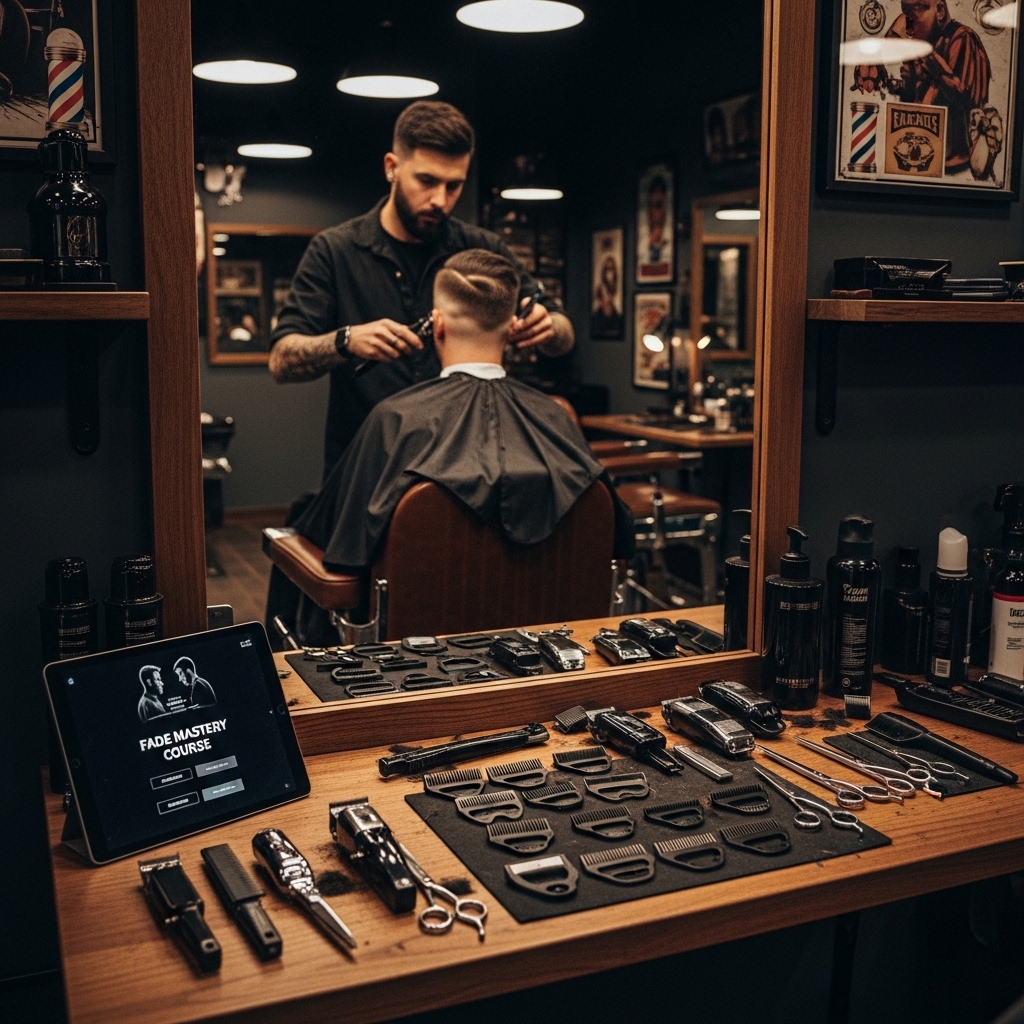
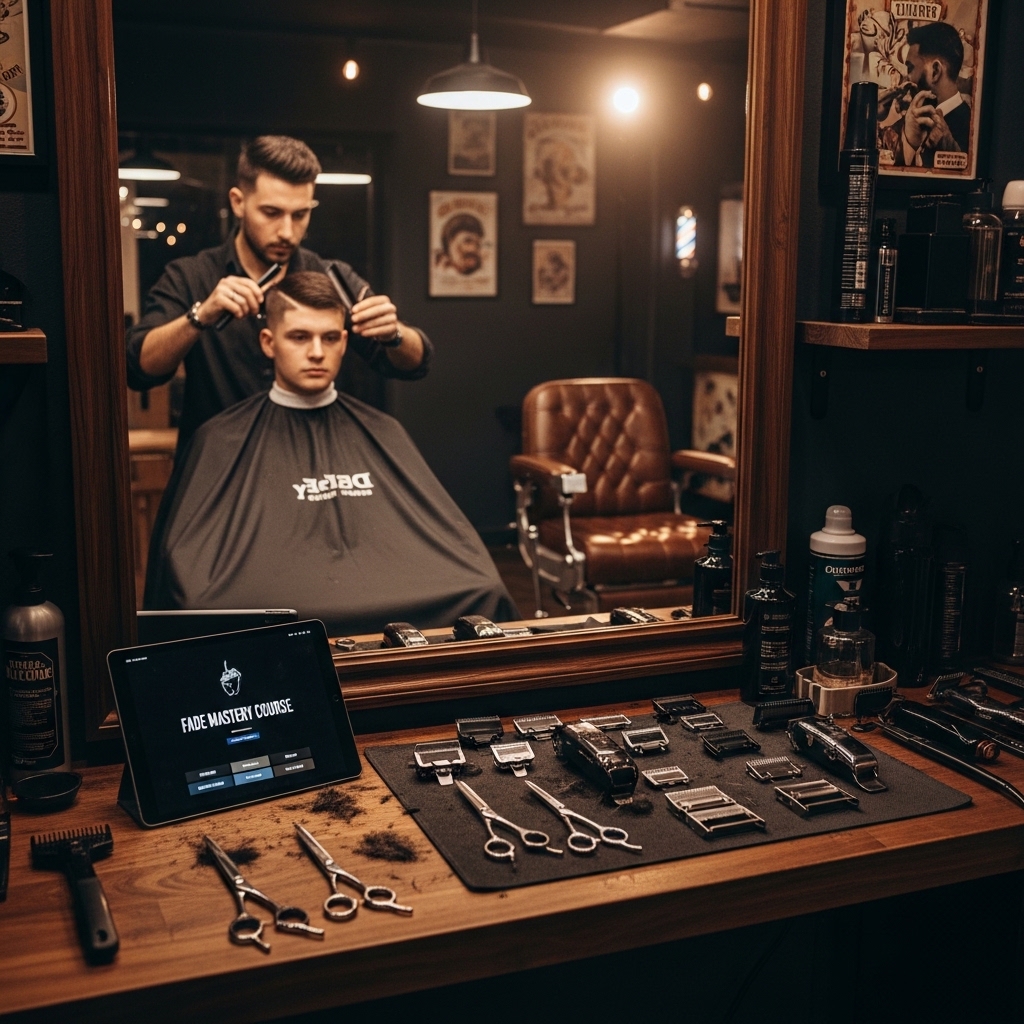
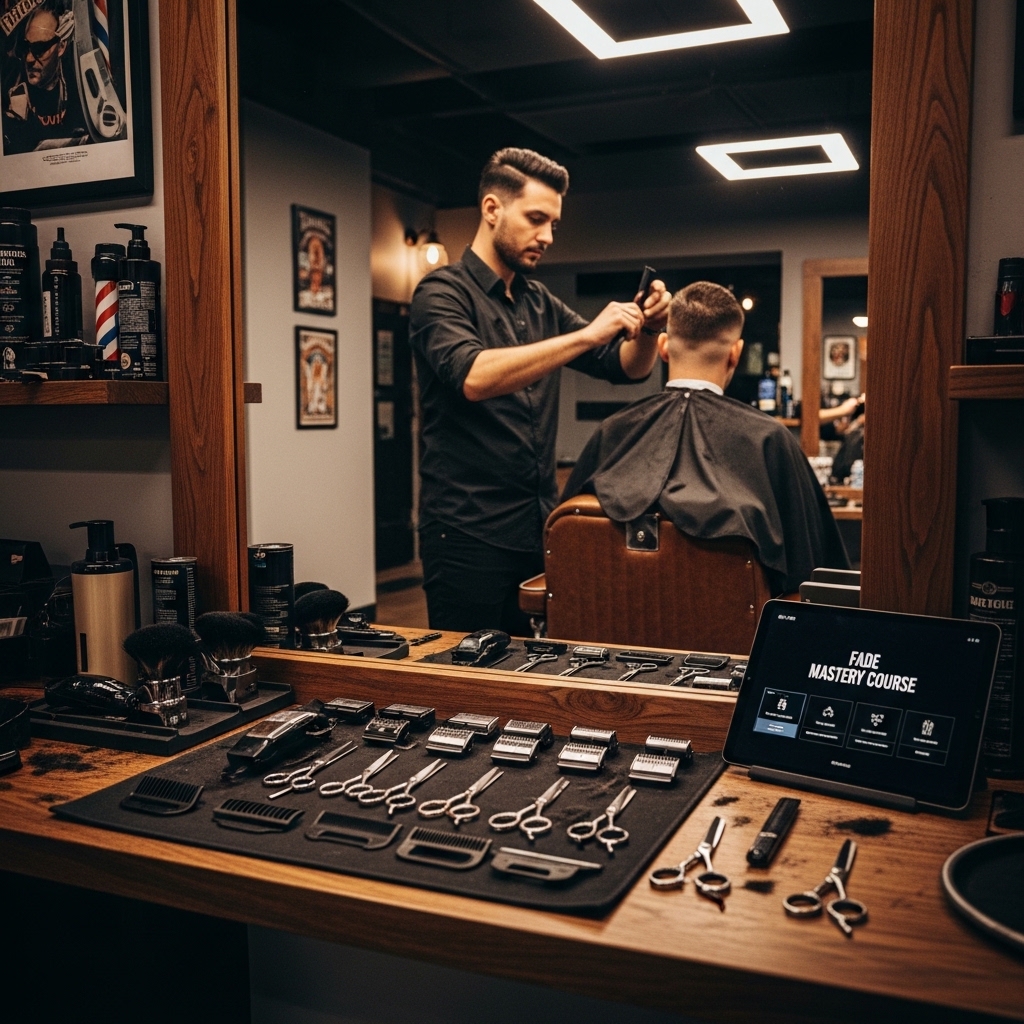
Men’s Fade and Taper Mastery Digital Course
The Complete Technical Curriculum for Barbers Who Want to Cut Fades That Are Sharp, Clean, Consistent, and Worth Every Penny of the Premium Ticket
The fade is the most technically demanding cut in the barbershop — and the one most clients judge first.
Not the shape. Not the length. The blend. The gradient. The seamless transition from skin or shadow at the nape and sides through the low, mid, or high fade zone into the longer hair above. The transition that takes a second under bright light. The one the client checks in the mirror by angling their head exactly right to see whether the blend is clean.
A great fade cannot be hidden. Neither can an average one.
The barber who produces consistently exceptional fades — regardless of head shape, hair texture, grain direction, or fade height — is the barber whose clients refer their friends specifically for fades, whose social content gets saved by other barbers, and whose chair never has a slow day. The technical reputation that is hardest to build is also the most durable: nobody unsees a truly clean fade.
The Li-Bar Men’s Fade and Taper Mastery Digital Course is the systematic technical curriculum for developing that level — from the fundamental principles through the advanced techniques through the problem-solving skills that produce a clean result on every head, every time.
📥 Li-Bar digital download. Instant access. Complete technical library.
THE CURRICULUM — MODULE BY MODULE
MODULE ONE: THE ANATOMY OF THE FADE
Understanding the Head Shape in Three Dimensions
The fade is not applied to a flat surface — it is applied to a curved, three-dimensional head shape that varies significantly between clients. The barber who does not understand how the head’s geometry affects the appearance of a blend will produce results that look clean during the cut and reveal problems when the client moves into different lighting or angles their head.
The head shape anatomy: the occipital bone prominence (the round protrusion at the back of the head that creates the most technically challenging blending zone — the low fade that blends cleanly on a head with minimal occipital prominence requires a different technique on a head with strong occipital prominence), the temporal recession (the recessed zones at the temples that affect the high fade placement and the shape line), and the neckline shapes (the straight neckline, the rounded neckline, and the tapered neckline — their natural growth pattern, the cut-to-shape technique, and the natural-versus-blocked decision based on the client’s preference and the hair’s natural fall).
The head shape assessment at consultation: the tactile and visual assessment of the occipital bone, the temporal zone, and the neckline growth pattern before any tool touches the hair — the two-minute assessment that determines the approach for the entire cut. 💈
The Hair Texture Variables
The technical variables introduced by different hair textures and how each affects the fade approach:
Straight fine hair: The texture that shows every blending imperfection most clearly because the hair lies flat and even against the scalp, creating a mirror-like surface that reflects light consistently. The precision requirement, the guard progression that produces clean blending without texture-induced visual noise, and the scissor-over-comb technique that manages the fine-to-zero transition.
Straight coarse hair: The texture that requires more blending effort than fine hair because the individual strands are thicker and the transition between guard lengths is more abrupt. The cross-checking technique, the blending clipper usage, and the freehand fade technique for the coarse-hair client.
Wavy and curly hair: The texture that hides blending imperfections better than straight hair in the finished state but that produces the most technically challenging mid-cut phase — the curl pattern that changes as the hair is cut shorter creates visual inconsistency that can be misread as a poor blend. The directional cutting approach, the curl pattern management, and the dry-cut assessment for curl pattern clients.
Tightly coiled and afro-textured hair: The texture with the highest shrinkage factor (the percentage difference between the wet length and the dry, natural length), the most complex grain direction patterns, and the visual density that produces the signature clean, sculptural fade that many clients specifically seek. The afro-textured hair fade technique — the guard selection that accounts for shrinkage, the grain direction mapping across the sides and nape, and the balding fade technique for the skin-fade client with afro texture. ✂️
MODULE TWO: THE TOOLS AND THEIR FUNCTIONS
The Clipper Selection and Maintenance Guide
The technical performance of different clipper types and the applications each is suited for:
The taper clipper: The standard fade clipper — the zero gap setting, the lever action, and the blade type selection. The taper clipper’s performance across hair textures and the maintenance protocol (the blade alignment, the tension adjustment, the blade oil frequency and technique) that maintains cutting performance and prevents the tugging that creates discomfort and ragged lines.
The cordless clipper: The flexibility and the motor power considerations — the cordless clipper that maintains consistent power through a charge cycle versus the one that loses cutting power as the battery depletes and why this matters for mid-fade consistency. The cordless clipper maintenance protocol.
The trimmer and outliner: The tool for the detail work — the hairline, the neckline, the bald fade’s final zero, and the shape line. The trimmer blade types (the standard guide blade versus the zero-gap trim blade versus the slimline T-blade), their applications, and the zero-gap adjustment technique for the skin-fade finish.
The shaver: The foil shaver versus the rotary shaver for the skin fade — the finish quality difference, the skin type consideration, and the integration of the shaver into the fade workflow without creating a line of demarcation between the shaved zone and the clipper zone. 🔧
The Guard Progression System
The guard set used in the fading process: the guard numbers, their metric length equivalents, the visual length difference between each step, and the progression sequences used for low, mid, high, and bald fades at different hair textures. The guard removal progression — the technique that removes the guard for the zero-guard fade zone — and the freehand technique that blends the zero-guard zone into the guarded zone above it.
MODULE THREE: THE FADE TECHNIQUES — EVERY STYLE
The Low Fade
The technical parameters of the low fade: the origin point (the position on the side and nape where the fade begins — approximately one to two finger-widths above the ear and the natural hairline), the progression technique (the guard sequence from zero at origin through the blending guards to the length above), and the arch shape (the curved line that follows the ear shape versus the straight horizontal line — the choice based on the client’s preference and the head shape).
The low fade execution: the zoning system (the map of each guard’s zone on the side and nape before the first clipper pass), the flicking technique (the clipper movement that blends guard transitions by tapering the guard out before the transition line), the cross-check pass, and the zero-guard finishing technique. The low fade on each hair texture — the technique adjustments for fine straight, coarse straight, wavy, and coiled hair types.
The Mid Fade
The technical parameters of the mid fade: the origin point (the midpoint of the side, approximately at the temple curve), the progression technique, and the transition management across the temporal recession zone (the most technically challenging aspect of the mid fade — the concave area that creates an abrupt visual transition if not addressed specifically with the open-lever blending technique).
The High Fade
The technical parameters of the high fade: the origin point (at or above the temples, approaching the parietal ridge), the guard progression through the largest fade zone on the head, and the crown blend technique where the fade zone meets the top section. The high fade on round and square head shapes — the technique adjustments that account for the head shape’s effect on the fade’s visual appearance from different angles.
The Skin Fade / Bald Fade
The most technically demanding fade variant: the fade that transitions to skin, with no guard, no hair, and therefore no margin for inconsistency in the blend zone.
The skin fade execution: the preparation (the hair length at each zone before the skin fade begins), the guard progression through zero to freehand, the open-lever blending technique that creates the transition from the shortest guard into the freehand zone, the freehand technique without a guard (the clipper angle, the movement arc, and the pressure that removes hair at the skin level without creating lines), the trimmer and shaver integration for the final skin-level finish, and the skin fade line — the upper boundary of the skin zone — cut with the outliner with the precision that defines the entire cut.
The skin fade troubleshooting: the track line (the line created by an inconsistent clipper angle or pressure during the freehand pass), the shadow line (the line visible at the transition between the freehand zone and the shortest guard zone), and the correction technique for each. 💡
The Taper — The Alternative to the Fade
The technical distinction between the fade and the taper: the taper that uses the hair’s natural graduation rather than clipper-created blending to produce the length transition. The taper’s application for the client who wants a cleaner look than uncut sides but does not want the fade’s shaved appearance. The taper execution technique and the hybrid taper-fade for the client whose head shape benefits from a combination.
MODULE FOUR: THE SHAPE AND DESIGN WORK
The Neckline Design
The three neckline options and the technique for each: the straight blocked neckline (the horizontal cut line that creates a clean, defined finish — the technique for the straight-across cut that compensates for the head’s curve to produce a visually level line), the rounded neckline (the technique for following the natural neckline shape while cleaning the growth below it), and the V-taper neckline (the tapered finish at the center nape that creates a natural-looking grow-out).
The natural hairline versus the edged hairline decision: the conversation with the client that identifies which finish they prefer and the cultural context that affects this preference — the guide for approaching this conversation with cultural awareness and without assumption.
The Lineup and Edge Work
The hairline edge: the technique for the straight razor or trimmer outline that defines the front hairline, the temple taper, and the sideburn. The freehand edge technique (the technique without a comb guide — the technique that produces the cleanest, most precise line but that requires the most hand steadiness and spatial judgment), and the comb-guided edge technique for the barber developing freehand confidence.
The beard line-up as a service component: the neck line below the beard, the cheek line, and the mustache trim — the service that makes the haircut-and-beard combination the complete grooming experience that the premium client expects and the premium price reflects. ✨
MODULE FIVE: THE CONSULTATION AND COMMERCIAL SKILLS
The Men’s Cut Consultation
The consultation for a barbershop client: the efficient but complete consultation that identifies the required fade height, the required length on top, the neckline preference, and any specific styling goals — in the three minutes available before the client’s patience for pre-cut discussion is exhausted. The consultation vocabulary (the communication of fade heights in language the client understands — the “skin,” “shadow,” “low,” “mid,” “high” vocabulary that most clients know and the translation from the client’s description to the technical execution), and the reference image interpretation (the assessment of a client’s reference image against the client’s actual hair type, head shape, and maintenance willingness — and the communication of any required adaptations).
The Premium Service Positioning
The commercial framing of a premium fade service: the language that communicates the skill, time, and attention that goes into a precision fade — the conversation that makes the premium ticket feel earned before the client sits in the chair. The upsell opportunity: the beard service, the scalp treatment, the hot towel finish — the additions that convert a standard cut booking into a complete grooming appointment. 💰
📂 COMPLETE LI-BAR FILE SUITE
✂️ Complete Fade and Taper Mastery Course PDF — all five modules (A4 and US Letter, illustrated throughout) | 📐 Head Shape and Fade Zone Diagram Library (PDF — full color, printable for station reference) | 🔧 Clipper and Tool Maintenance Guide (PDF) | 📊 Hair Texture Technique Adjustment Reference Card (laminate-ready PDF) | 💡 Skin Fade Troubleshooting Guide — 8 common problems with corrections (PDF) | 📋 Men’s Cut Consultation Reference Card (laminate-ready, pocket-sized) | ✨ Guard Progression Quick Reference by Fade Style and Texture (PDF)
100% digital. Instant download from Li-Bar. The technical foundation for fades that people come back for — and refer their friends for.
A clean fade is not luck. It is knowledge, applied with consistency. This course builds both.
Reviews
There are no reviews yet.